The Business Behind the Ballon d'Or: Who Owns It, Who Gets Paid?
An award created by a football magazine now carries value through commercial rights, sponsorships and contract clauses negotiated far beyond the ceremony.

The Missing Cheque
In 2015, Manchester United agreed to sign Anthony Martial from Monaco. Among the reported terms was an unusual possibility: Monaco could receive another €10 million depending on where the young forward finished in the Ballon d'Or rankings.
Not for a United trophy. For a ranking decided outside either club.
Subsequent reports disagreed about the required position, and there is no established payment of that particular bonus. But the arrangement raises a larger question: how did an award created by a French football magazine become a financial condition in a major transfer?
The Ballon d'Or has no publicly reported organizer-funded cash prize. Its commercial value works differently. The people who choose the winner do not have to be the people who pay for what winning represents.
The Magazine and the FIFA Years
France Football established the Ballon d'Or in 1956, with Stanley Matthews as its first winner. Initially limited to European players, eligibility followed football's widening international reach: non-European players at European clubs became eligible in 1995, and players worldwide in 2007. Those changes broadened the field of contenders and the award's relevance beyond its original European constituency.
The institutional identity changed again in 2010, when France Football and FIFA combined their individual awards into the FIFA Ballon d'Or. Their partnership ended after 2015. France Football continued its own award, while FIFA presented The Best separately. In 2022, the Ballon d'Or also moved from calendar-year assessment to season-based evaluation.
Each change affected who could be recognized, who helped confer authority and what the award represented internationally. But the institution behind the Ballon d'Or remained a media business, even as a new commercial partner arrived.
Ownership and Voting
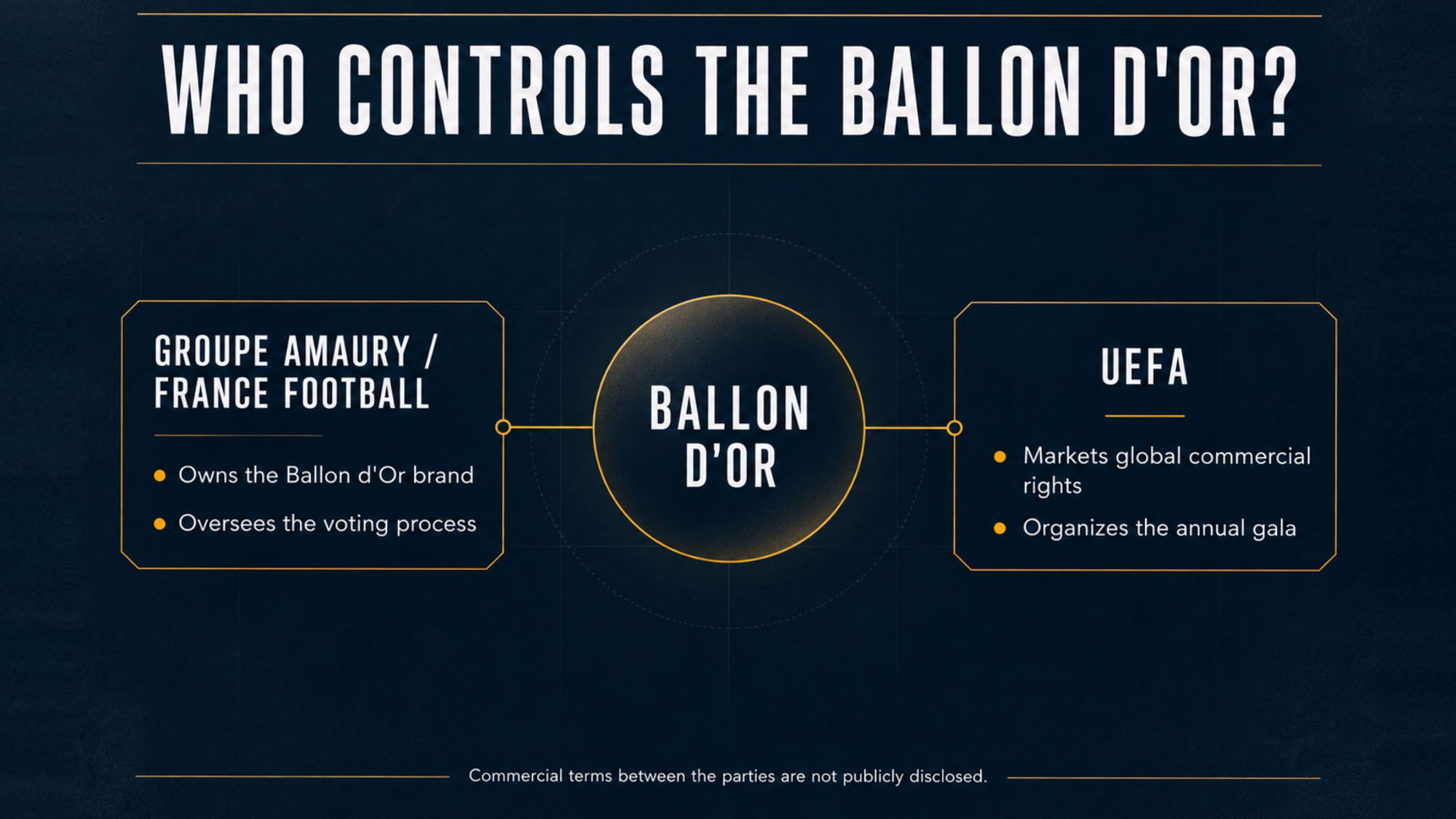
Groupe Amaury, the French media group behind France Football and L'Équipe, owns the Ballon d'Or brand. UEFA's prominent role in the modern ceremony did not change that ownership.
Under their November 2023 agreement, implemented from 2024, Groupe Amaury retained the brand and oversight of voting. UEFA undertook to market global commercial rights and organize the annual awards gala.
Those are distinct responsibilities. Ownership protects the name and institutional identity. Voting supplies the sporting judgment. Rights marketing and event organization turn attention around that judgment into opportunities for commercial partners.
The award uses a journalist-based voting process under published criteria. The partnership expressly describes the voting system as independent. A broadcaster can distribute the ceremony; a sponsor can associate its brand with the occasion. Neither role gives that company a vote.
The public agreement also does not disclose how commercial receipts are divided between UEFA and Groupe Amaury. Managing rights is not the same as owning the award, and an announced partnership is not a financial statement.
Commercial Rights and Partners
Unlike a football league, the Ballon d'Or has no weekly schedule of matches to sell. Its commercial proposition is concentrated around one annual result, the ceremony and the attention that surrounds them.
For 2026, DAZN announced live, free streaming in 200 markets, subject to territorial exclusions and separate local arrangements. It also became a Global Gold Sponsoring Partner. Distribution puts the event in front of viewers; sponsorship associates the DAZN brand with the award and its coverage.
Hankook returned as an official sponsor for the third consecutive year, describing opportunities for international visibility and engagement with football fans, customers and partners. The company also offered a ticket competition linked to the gala.
The ceremony provides additional opportunities around attendance and hospitality. On 26 October 2026, the Ballon d'Or takes place at the London Palladium, bringing the event to England for the first time, though not outside France for the first time: the FIFA partnership years included ceremonies in Zurich.
These arrangements establish commercial activity, not its monetary yield. A free stream does not reveal a rights fee. A sponsorship announcement does not identify the sponsor's payment. Event access does not establish profit after costs. The structure is visible; its complete accounts are not disclosed in the reviewed material.
Beyond those institutional arrangements, the award can appear in contracts whose parties have no role in choosing its winner.
How the Ballon d'Or Became a Contract Clause
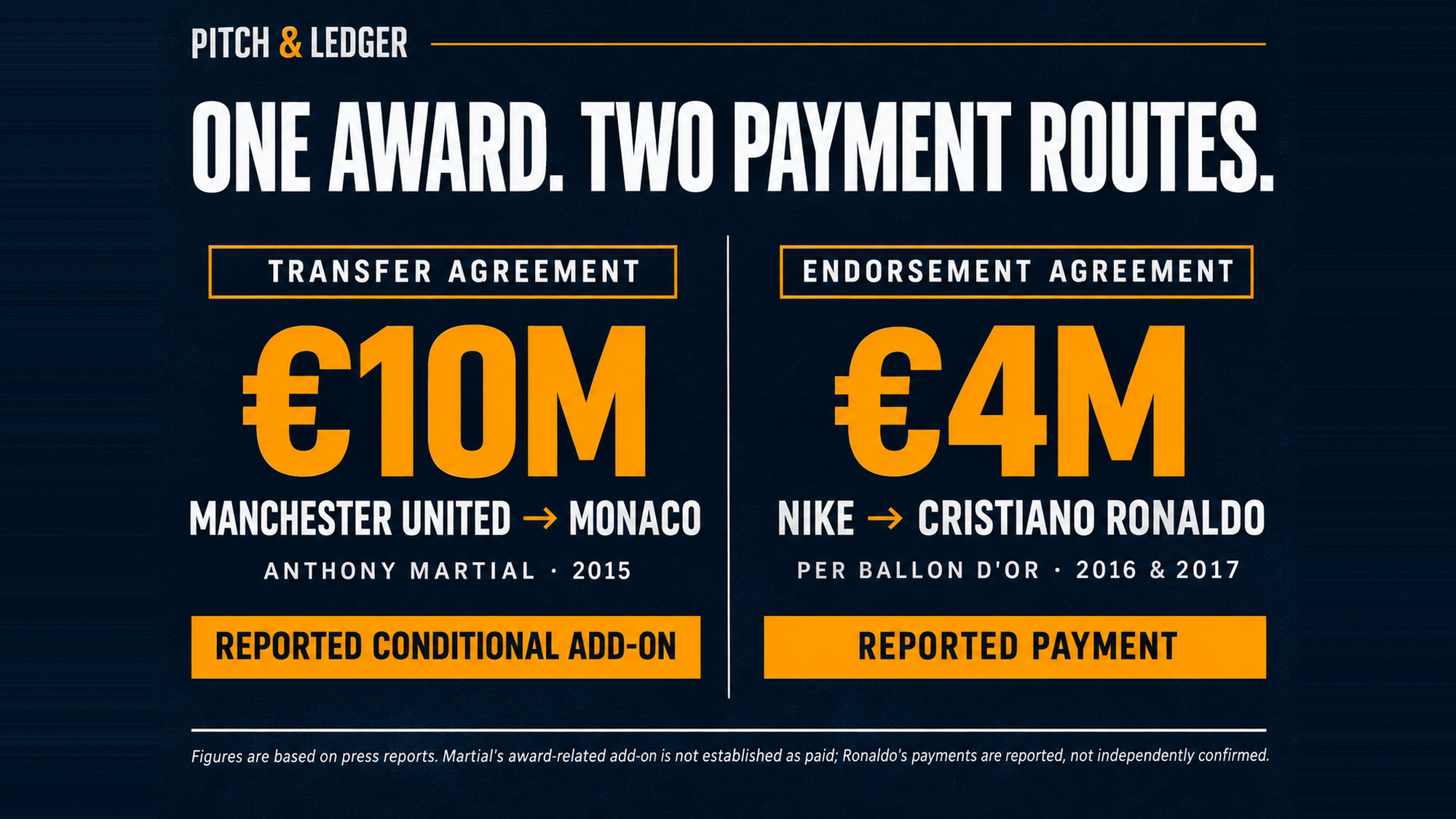
Return to Martial. L'Équipe reported a €50 million initial fee for his 2015 move to Manchester United, plus up to €30 million in add-ons. Three potential €10 million payments related to United goals, appearances for France and a Ballon d'Or ranking.
The direction of payment is the crucial detail. Under the reported award clause, United would owe Monaco, the selling club, if Martial reached the stipulated position. A judgment made by journalists could therefore affect the final consideration for a transfer between two clubs.
The exact threshold remains unsettled in the reports: L'Équipe's 2015 account said top 10, while its 2016 account of leaked terms said top three. In 2017, it again referred to top 10 while reporting that Martial's 25th United goal had activated a separate €10 million add-on. That report does not establish a Ballon d'Or-related payment.
Cristiano Ronaldo presents a second route: sponsor to athlete rather than buying club to selling club.
In 2019, Bloomberg reported figures from Der Spiegel’s coverage of a draft agreement between Nike and Polaris Sports. The figures included an annual base fee of €16.2 million. Bloomberg reported that Nike paid Ronaldo an additional €4 million for his 2016 Ballon d'Or victory and another €4 million for his 2017 victory — €8 million across the two awards, according to that report. Polaris held his worldwide marketing rights, according to that account.
Those are reported payments, not independently verified disbursements: the figures came from reporting on a leaked draft, and Nike and Polaris declined comment. The cited account specifically identifies the Ballon d'Or for those two years; any broader condition involving FIFA The Best would require the underlying agreement before being stated as fact.
For Monaco, the award ranking was reportedly a trigger for transfer consideration. For Ronaldo, victory was reportedly rewarded through an endorsement relationship. In neither example was the organizer responsible for that payment.
Employment agreements provide another route. After Karim Benzema's 2022 victory, AS reported a Real Madrid bonus of approximately €1 million. Relevo reported an automatic one-season extension, while later accounts questioned whether this was a written clause or a renewal understanding. Real Madrid announced his departure in June 2023; the precise extension mechanism and payment of the reported bonus remain unconfirmed.
Vinícius Júnior shows why the identity of the award matters. Rodri won the 2024 Ballon d'Or, while Vinícius subsequently won FIFA's The Best Men's Player award. AS reported in 2026 that the FIFA award activated a €2 million-per-season salary increase in his Real Madrid agreement, and that winning the Ballon d'Or would have been an alternative trigger. The private-contract claim is reported, not payroll-verified — and is not evidence of compensation for losing the Ballon d'Or.
Promise, Trigger, Payment
An award decided outside a contract can still provide an objective reference point for the parties signing it. That is why an individual ranking may affect a transfer, sponsorship or employment agreement even though none of those parties controls the Ballon d'Or ballot.
A contractual promise, a qualifying result and an actual payment are different stages. Martial's disputed ranking threshold illustrates uncertainty over the promise itself; Ronaldo's reported Nike payments concern the final stage, though without independent confirmation. Benzema's reported extension demonstrates why the contractual outcome cannot be assumed from the award alone.
The same caution applies to the ceremony. Broadcast and sponsorship partnerships establish commercial arrangements, not their disclosed returns. The award's influence is visible in the agreements built around it, even where the financial results remain private.
Conclusion
The Ballon d'Or began as a magazine's editorial judgment. Its modern structure connects a media owner, UEFA, broadcasters, sponsors, clubs and players without giving them the same responsibilities.
Groupe Amaury owns the brand and oversees voting. UEFA markets international rights and stages the gala. Other organizations can attach their own contractual obligations to the result.
The defining commercial feature is not a cheque handed over with the trophy. It is that an editorial decision can carry financial consequences in agreements written by people who never cast a vote.
Sources
- UEFA — Agreement to co-organise the Ballon d'Or Official announcement of UEFA's partnership with Groupe Amaury.
- UEFA — How Ballon d'Or winners are decided Voting system and published award criteria.
- UEFA — 2026 Ballon d'Or ceremony details Official ceremony date and London Palladium venue.
- DAZN Group — Global Ballon d'Or broadcast announcement Distribution arrangements and international coverage.
- Hankook — Ballon d'Or sponsorship renewal Corporate announcement of its third consecutive year as a sponsor.
- L'Équipe — Anthony Martial transfer bonus terms Reporting on conditional payments in the Manchester United–Monaco transfer.
- L'Équipe — Football Leaks and the Martial transfer agreement Additional reporting on the contractual add-on structure.
- The Straits Times — Cristiano Ronaldo's reported Nike agreement Secondary reporting on leaked contract figures attributed to Der Spiegel; reported terms are not independent confirmation of payment.
- AS — Karim Benzema's reported Ballon d'Or bonus Reporting on the financial incentive associated with Benzema's award.
- Relevo — Benzema's contract extension reporting Additional reporting on the contract implications of winning the award.
- AS — Reported terms of Vinícius Júnior's contract Reporting on performance-related salary incentives, including the FIFA The Best distinction.
- BBC Sport — History of the FIFA and Ballon d'Or partnership Background on the end of the joint award arrangement after 2015.
- AS — Does winning the Ballon d'Or include a cash prize? Reporting on the absence of a publicly disclosed organiser-funded prize for the 2025 award; distinct from private contractual bonuses.
- Real Madrid — Official announcement of Benzema's departure Club statement used to establish the subsequent employment timeline.
Pitch & Ledger
Get the systems behind the spectacle in your inbox.
Independent sports-business analysis, delivered free.