The Premier League Can't Copyright a Football Match. So What Is It Selling?
A pub in Southsea, a genuine Greek decoder card and a case that reached the European Union's highest court exposed an awkward fact inside the Premier League's television business: the match itself is not a copyright work. So what are broadcasters paying £6.7bn for?
The pub
The match was real. So was the card.
On 19 August 2006, and again on 25 September, Karen Murphy showed Premier League football to customers at the Red White and Blue, the pub she ran in Southsea, Hampshire.
She did not have a Sky subscription. She had cancelled it because of the cost.
What she had instead was a satellite dish, a decoder box and a viewing card for NOVA, a Greek broadcaster.
She had paid for the card. It was not counterfeit and it was not hacked. The courts proceeded on the basis that it was a genuine NOVA card.
Its problem was geography.
It had been issued for use in Greece. Murphy was using it in England. She reportedly paid around £800 a year for it.
Media Protection Services, the company retained by the Premier League to investigate and prosecute decoder-card cases, took her to court.
Portsmouth magistrates convicted her of two offences under section 297(1) of the Copyright, Designs and Patents Act 1988: dishonestly receiving a programme with intent to avoid the charge applicable to it.
She was reported to have been ordered to pay almost £8,000 in fines and costs.
Murphy appealed.
The appeal failed in the Crown Court and moved to the High Court, which in July 2008 sent questions on European law to the Court of Justice of the European Union in Luxembourg.
A parallel set of questions came from another High Court judge in a separate Premier League action against suppliers of foreign decoder cards and the publicans who used them.
A pub landlady's decoder card had become a question for the EU's highest court.
Its answer would expose something the Premier League's television deals rarely force anyone to ask:
What, exactly, is being sold?
What the court said
The Court of Justice gave its judgment on 4 October 2011, answering both references together.
On the decoder cards, it went Murphy's way.
EU law did not allow a member state to prohibit the import, sale and use of foreign decoding devices from another member state in the way at issue in the case. Exclusive licence terms requiring broadcasters to prevent their cards being used outside their allocated territory also restricted competition.
Why the court reached that conclusion is a story about the European single market, and a different one from this.
The answer that matters here came on another point: whether the Premier League could claim copyright in the matches themselves.
It could not.
A football match, the court said, cannot be classified as a copyright work.
Copyright protects intellectual creations. Football matches are played under rules that leave no room for the kind of creative freedom required for the match itself to qualify as a work.
That does not mean the match is legally unprotected.
In the next paragraph, the court recognised that sporting events have a unique and original character capable of making them worthy of protection, and left national law free to provide it.
The distinction matters.
The judgment does not say that a football match belongs to no one.
It says that the match itself is not a copyright work.
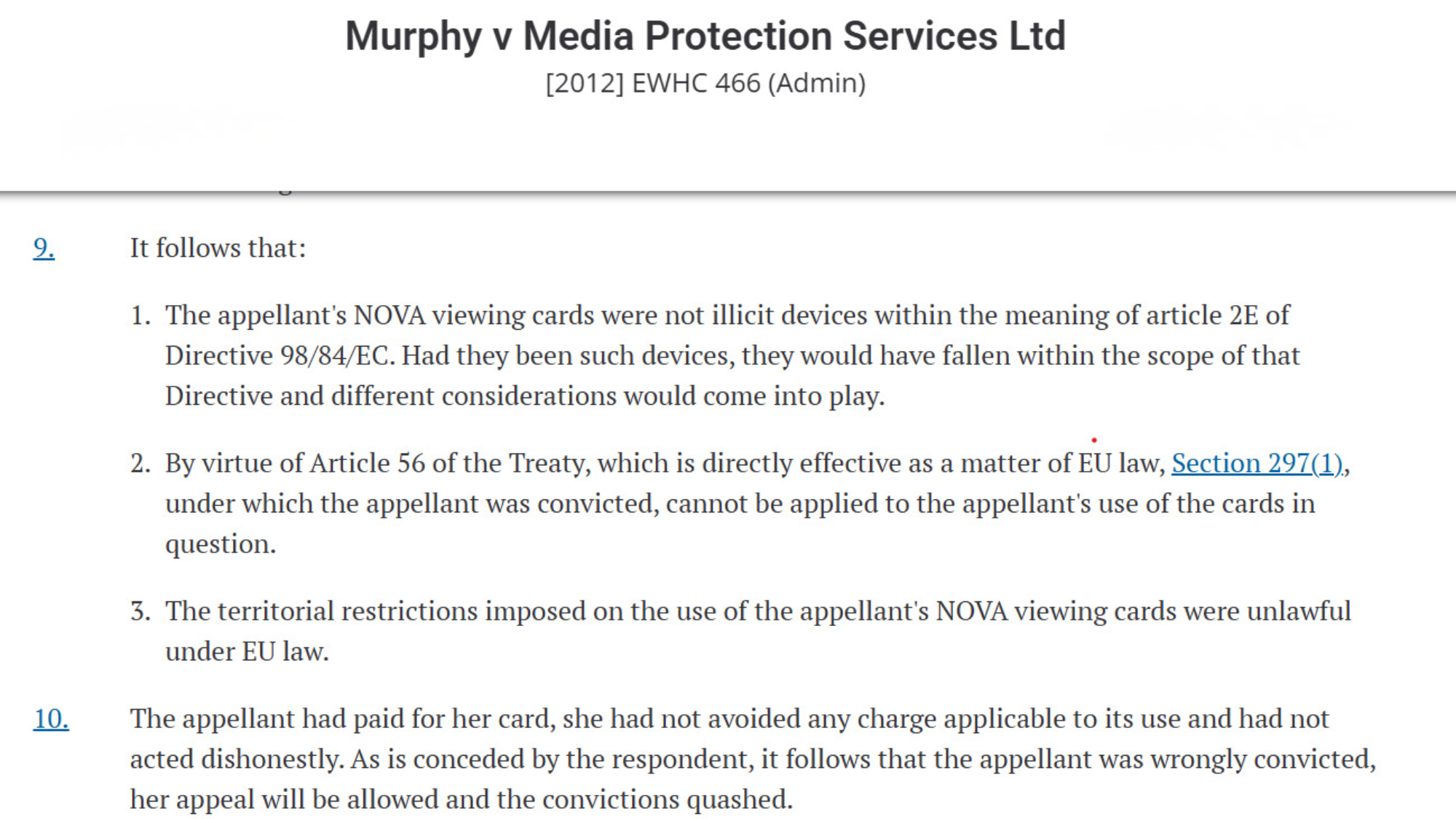
In February 2012, back in London, Murphy's conviction was quashed. The High Court concluded that she had paid for her card, had avoided no charge and had not acted dishonestly. The prosecutor conceded.
Which leaves the question the rest of this story turns on.
If the match is not a copyright work, what was the League enforcing?
The logo problem
Part of the answer was already inside the Luxembourg judgment.
Alongside the match, the court identified things carried in the coverage that were protected: the Premier League anthem, pre-recorded sequences, on-screen graphics and recorded footage.
The coverage carries the match.
But it also carries things somebody made.
The parallel High Court case showed what that distinction could mean inside a pub.
On 3 February 2012, three weeks before Murphy's conviction was quashed, the High Court ruled in the Premier League's action against QC Leisure and AV Station, suppliers of foreign decoder cards, and against publicans who had used them.
Applying the European court's ruling, the judge held that publicans screening foreign broadcasts of live matches could communicate the League's copyright works to the public, including its artistic works. The card suppliers were held to have authorised those acts.
But the judgment also drew a line.
Under the version of section 72 of the Copyright, Designs and Patents Act then in force, showing a broadcast in a pub to customers who had not paid for admission did not infringe copyright in any film included in that broadcast.
Put those holdings beside each other and the position becomes unusually revealing.
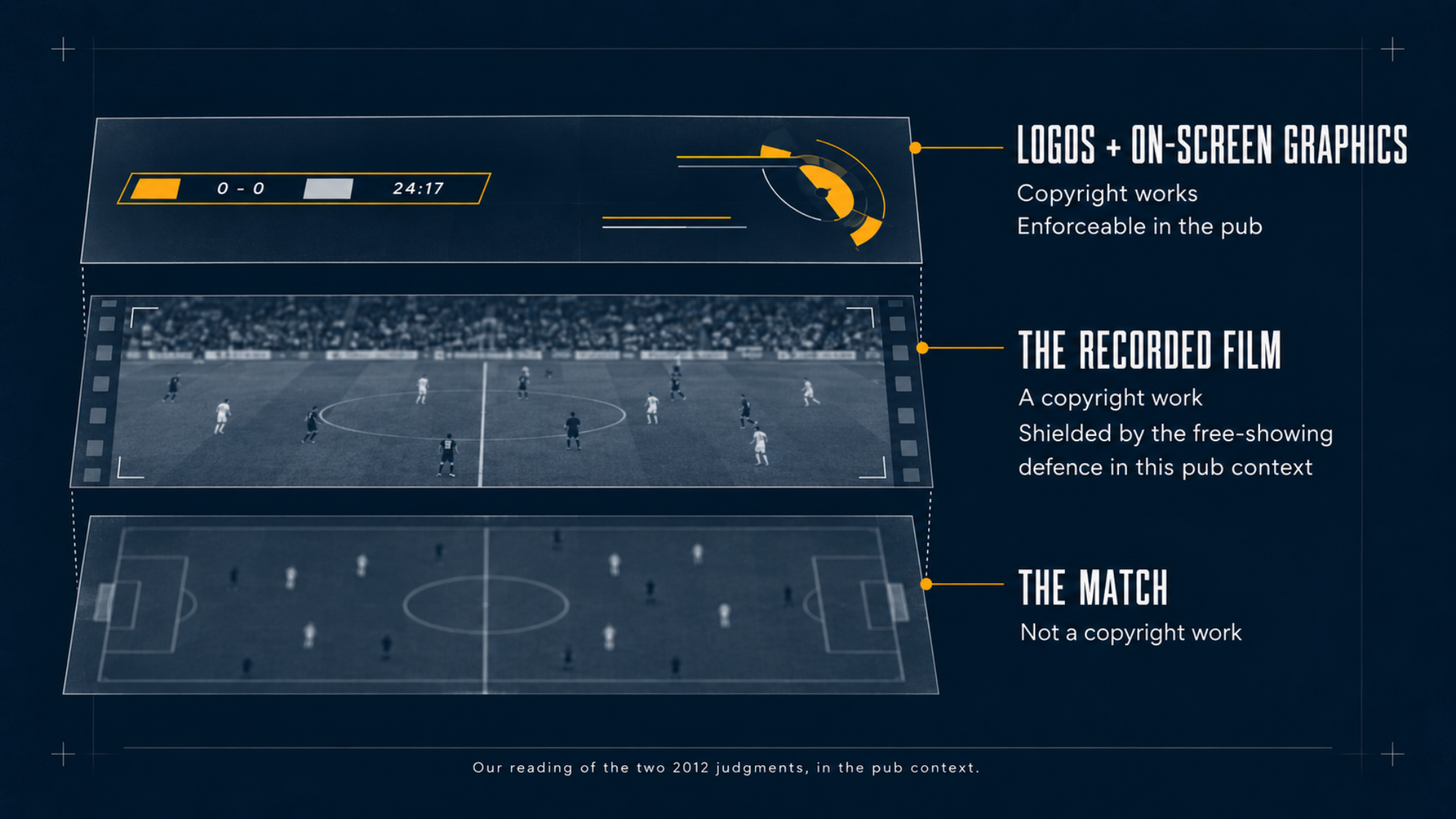
This is an interpretation of the judgments together, not a sentence taken from either one: in that pub context, the recorded film of the match was shielded by the statutory defence. What remained enforceable included artistic works layered into the coverage — a category later recorded as including the Premier League's logos and on-screen graphics.
The match on the pitch was not a copyright work.
The film of it was protected, but in that setting the film right was shielded.
The logos and graphics laid over it were not.
Murphy herself was not a party to that copyright case.
When her appeal was decided, the High Court said expressly that its judgment had no bearing on the copyright issues decided separately in QC Leisure.
Her criminal conviction and the League's copyright enforcement were related parts of the same decoder-card fight.
They were not the same legal question.
What the League actually owns
So who makes the things that are protected?
The Premier League is not a separate business that buys football from twenty independent clubs and resells it.
A 2008 High Court judgment described FAPL as the vehicle through which the twenty clubs operate the competition. Each club holds one share.
Among the League's activities are organising the filming of matches and licensing rights to broadcast them.
The first part matters more than it sounds.
The clubs do not each produce a finished television product and then hand it to the League.
The League organises the filming.
The media asset is built inside a structure the clubs operate together.
A later High Court case, in 2013, went further. The court accepted evidence that copyright subsisted in the recorded World Feed and action-replay films, and in artistic works including Premier League logos and on-screen graphics, and that FAPL owned those copyrights.
That finding needs its context.
It arose in an application seeking to force six internet service providers to block access to the FirstRow Sports streaming site.
The defendants did not appear and were not represented. The site operator did not appear. The judge decided the application on paper.
The ownership evidence was therefore unchallenged.
It is a judicial finding.
It is not a contested ownership ruling.
And it is narrower than saying the League somehow owns the football match.
What the cases identify are specific produced works: the recorded feed, replay films, logos and graphics.
The asset is beginning to take shape.
Not the match itself.
The media product built around it.
From produced coverage to £6.7bn
A recording is not yet a business.
The licence is what turns it into one.
The clubs authorise the Premier League to license broadcasters around the world to provide coverage of Premier League matches.
That is how the High Court described the arrangement in 2013. The European Commission had described the seller in similar terms earlier: the League sells the media rights on behalf of its member clubs.
The underlying instrument through which the clubs give that authority is not public.
The courts establish that the authorisation exists. They do not disclose its contractual form.
From there, the League can turn produced coverage into inventory.
Rights are offered by competitive tender for a defined territory and a defined term, with the UK and Ireland sold separately from other markets.
And the League does not sell Arsenal, Liverpool or Manchester United as individual television products.
It sells packages.
Those packages are organised around kick-off slots.
For the current UK cycle, running from 2025/26 through 2028/29, the League went to market in October 2023 with five live packages covering approximately 270 matches per season.
The awards were announced that December.
Sky Sports took packages B, C, D and E, covering a minimum of 215 live matches per season.
TNT Sports took package A, covering 52.
The BBC took free-to-air highlights rights for all 380 matches.
The Premier League values those agreements at £6.7 billion across the four seasons.
In June 2026, the League stated that a minimum of 267 matches per season would be broadcast live in the UK: at least 215 on Sky and 52 on TNT.
That is not the same number as the approximately 270 matches offered when the rights were tendered in 2023.
The League has not explained the difference, so neither should we.
But the commercial chain is now visible.
A sporting event that is not itself a copyright work is filmed under the League's organisation.
That coverage contains produced works in which copyright can subsist.
The clubs authorise the League to license coverage.
The League turns the season into packages defined by time slots.
Those packages are sold by territory and term.
That is the inventory to which billions of pounds attach.
Not ninety minutes in isolation.
Where the money goes
The money then returns to the clubs that authorised the sale.
But even here there is no single distribution rule.
UK broadcast revenue is divided on a 50:25:25 basis: half equally, a quarter according to final league position and a quarter according to live television appearances.
International broadcast revenue follows a different formula. Clubs continue to share the pre-2019/20 level equally, while growth above that level is distributed according to finishing position.
Central commercial revenue is shared equally.
The clubs also agreed a formula limiting the ratio between the highest and lowest central payments to 1.8 to 1.
That is a constraint the clubs set for themselves.
It is not a regulatory cap.
What this doesn't prove
Two limits matter before returning to Southsea.
First, none of this proves that central selling is the optimal arrangement for football, or that pooling television revenue produces competitive balance.
Those are separate questions.
This article establishes how the product is assembled and licensed, not whether the system produces the best possible sporting outcome.
Second, Karen Murphy's case is history.
The events ran from 2006 to 2012 and the European-law rulings were delivered while the United Kingdom was a member of the European Union.
They help explain what the courts found the Premier League could — and could not — protect at that moment, and they expose the distinction between the match and the media product built around it.
They do not tell a pub what it may lawfully show in Britain today.
Back in Southsea
Back at the Red White and Blue, the arithmetic had looked simple.
Murphy reportedly paid around £800 a year for a Greek decoder card.
And the card did deliver Premier League football.
But what came through the dish was never just the match.
It was produced coverage: a recording organised within the League's system, carrying protected graphics, licensed to a broadcaster for a particular territory.
The match was played on the pitch.
What Murphy paid to reach was the product built around it.
Sources
Primary sources
- Court of Justice of the European Union — FAPL v QC Leisure / Murphy Primary source · 2011-10-04 · Football matches are not copyright works; protected works carried in the coverage; national protection left open.
- High Court — Murphy v Media Protection Services Ltd [2012] EWHC 466 (Admin) Primary source · 2012-02-24 · Murphy's pub, decoder-card use, prosecution, appeal history and quashing of her conviction.
- High Court — FAPL v QC Leisure [2012] EWHC 108 (Ch) Primary source · 2012-02-03 · Copyright treatment of artistic works and films when foreign broadcasts were shown in pubs.
- High Court — FAPL v QC Leisure [2008] EWHC 1411 (Ch) Primary source · 2008 · Premier League as the vehicle through which the twenty clubs operate the competition; League organises filming and licenses broadcast rights.
- High Court — FAPL v British Sky Broadcasting Ltd & Ors [2013] EWHC 2058 (Ch) Primary source · 2013-07-16 · Club authorisation; territorial tender structure; copyright in recorded World Feed, action replays, logos and on-screen graphics; context of the unopposed ownership finding.
- High Court — Media Protection Services Ltd v Crawford [2012] EWHC 2373 (Admin) Primary source · 2012-08-16 · Media Protection Services retained by the Premier League to investigate and prosecute decoder-card cases.
- European Commission — Case COMP/38.173 Primary source · 2006-03-22 · Media rights sold by the Premier League on behalf of its member clubs; historical Article 9 commitments.
- Premier League — Broadcast FAQ / How much money do clubs receive? Primary source · UK 50:25:25 broadcast distribution; international distribution structure; central-payment ratio.
- Premier League — Invitations to Tender for UK audio-visual rights Primary source · 2023-10-18 · Five live packages across four seasons and approximately 270 matches per season offered to tender.
- Premier League — UK live rights and free-to-air highlights awards Primary source · 2023-12-04 · Sky packages B–E and minimum 215 matches; TNT package A and 52 matches; BBC highlights for all 380; £6.7bn across four seasons.
- Premier League — Why Premier League matches move after fixtures are released Primary source · 2026-06-19 · Minimum of 267 matches broadcast live in the UK, including minimum 215 for Sky and 52 for TNT.
Context sources
- Contemporary reporting on Murphy's fines, costs and decoder price Context source · 2011-2012 · Reported figure of almost £8,000 in fines and costs and reported decoder cost of about £800 per year.
Pitch & Ledger
Get the systems behind the spectacle in your inbox.
Independent sports-business analysis, delivered free.