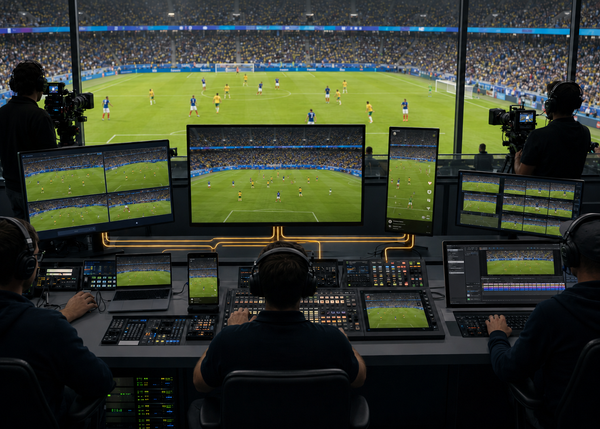
The World Cup Is FIFA's Operating System
The tournament lasts a month. The system behind it collects billions through rights FIFA controls, and pays them back out through rules FIFA writes.
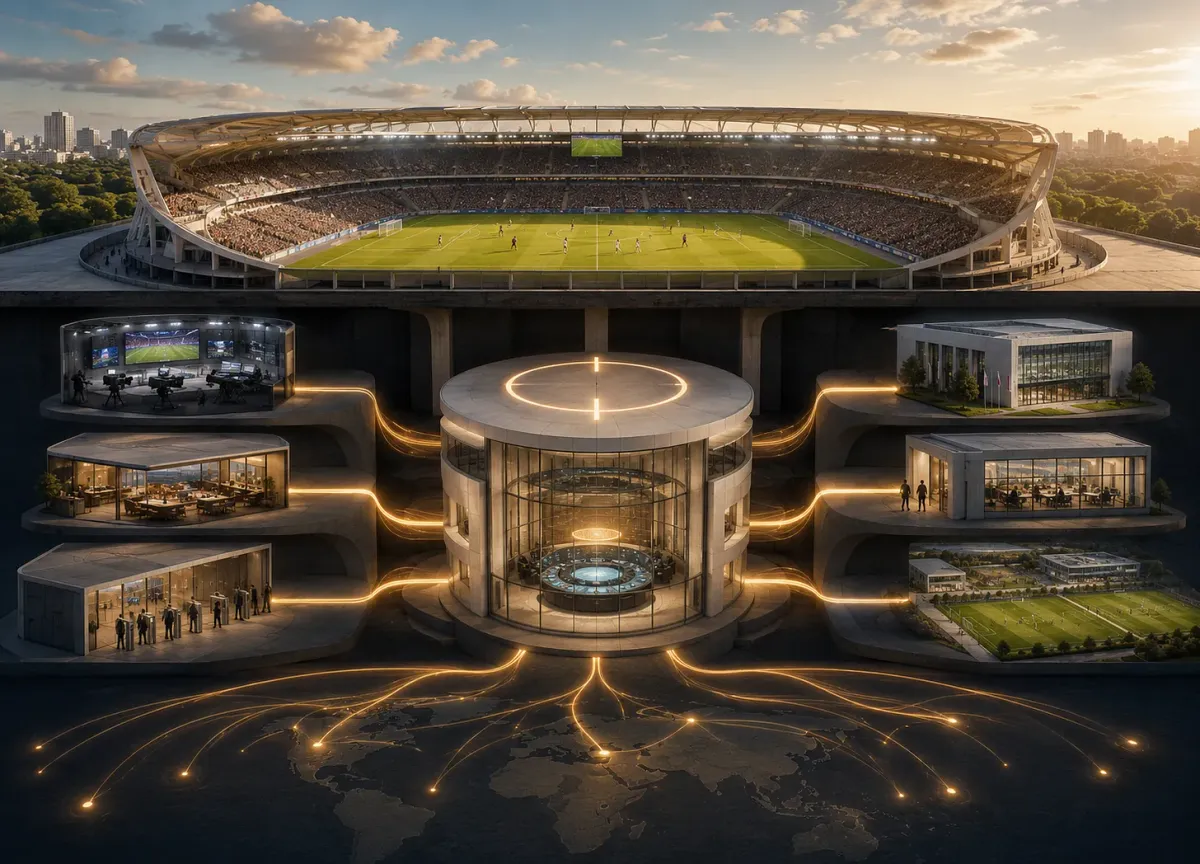
For a month every four years, the World Cup is exactly what it looks like on the screen: a bracket of matches, a trophy, a champion.
That is the product the public consumes.
It is not the only product FIFA sells.
FIFA does not book the World Cup only as a tournament. It books it as the revenue peak of a four-year commercial cycle — and the tournament accounts for most of that cycle's commercial revenue. In the 2019–2022 period, FIFA reported total revenue of about $7.57 billion, the large majority of it tied to the Qatar World Cup. By the time the first whistle blew in Doha, the cycle's biggest financial decisions had already been made and paid for.
And those decisions had little to do with the fan in the seat.
According to FIFA's own accounts for that cycle, the largest single source of revenue was the sale of television broadcasting rights: roughly $3.43 billion, about 45 percent of everything FIFA took in. Marketing rights — the sponsors — added about $1.8 billion. Licensing brought in $769 million. Ticketing across all 64 Qatar matches generated $686 million, with hospitality contributing around $243 million more.
Read the figures in order and the fan-facing picture becomes incomplete.
The person who buys a ticket is not the center of the page. FIFA's business is not built primarily around selling seats; it is built around selling rights — the exclusive right to broadcast the matches onto every screen on earth, and the right to attach a brand to the most-watched event in the world.
The pattern is clear: the stadium matters, but the screen matters more.
The football creates a global audience. FIFA packages that audience into commercial inventory and sells access to it. That is why the World Cup behaves less like a simple event and more like a rights platform.
The platform, scaled up
2026 is that platform enlarged.
FIFA originally budgeted the 2023–2026 cycle at $11 billion, with broadcasting alone projected near $4.26 billion. Its revised budget, published in its 2024 annual report, raised the cycle's revenue target by $2 billion, to around $13 billion. The jump from 32 teams to 48 — from 64 matches to 104 — is usually described as a sporting decision. Commercially, it is something simpler: more matches mean more broadcast windows, more sponsor exposure, more ticketed capacity, more hospitality inventory.
Expanding the tournament expands the things FIFA can sell.
More football is more sellable surface.
The half nobody watches
But revenue is only one half of the machine.
The other half is less visible, and more important to power.
FIFA does not just collect the game's money. It decides where that money goes — and that is where its real position inside football becomes clear.
The redistribution is large and rule-bound. For 2026, FIFA raised the pool paid to participating teams to a record $871 million, with the champion alone taking $50 million and every qualified nation guaranteed at least $12.5 million. Separately, its Club Benefits Programme will pay clubs $355 million for releasing players — up about 70 percent from the $209 million paid after Qatar 2022, and, for the first time, extended to clubs whose players feature only in qualifiers, reaching clubs across all six confederations.
Above all of it sits FIFA Forward, which channels $2.25 billion across the cycle to member associations under defined development rules.
None of that money moves on its own.
It moves through eligibility conditions, performance brackets, application processes, and development criteria that FIFA writes and administers.
Both ends of the ledger
Put the two halves together and the structure comes into focus.
FIFA stands at both ends of the World Cup economy.
It sets the terms on which the tournament's global commercial value is captured, and it sets the terms on which that value is paid back out. The first makes it rich. The second makes it powerful.
This is not an accusation of wrongdoing. It is a description of position.
When a national federation's budget depends on Forward funding, when a club's finances assume release compensation, when an association's prize money runs through a FIFA-defined structure, the money is doing more than rewarding football. It is creating dependency — and dependency is leverage.
The same institution that decides what a broadcast slot is worth also decides what a federation receives, and on what conditions.
Consider what that means at the edges.
FIFA's own development rules identify member associations whose annual revenues do not exceed $4 million as those most in need of support — and there are many of them. To each of its 211 members, FIFA offers the same Forward ceiling: up to $8 million across the 2023–2026 cycle, most of it for operating costs and the rest for approved projects, with additional travel and equipment money for the associations most in need.
For a large federation, that sum is a useful contribution.
For one whose entire annual income sits below $4 million, FIFA's money is not a supplement. It can be a large share of the budget.
And each of those 211 associations — the smallest of them heavily dependent on FIFA funding — casts one equal vote in the FIFA Congress, including the vote that elects the president.
That is the mechanism in a sentence: FIFA helps fund the members who decide who runs FIFA.
No rule has to be broken for that to matter. The point is not that the system is illegal. The point is that financial dependency and institutional power sit inside the same structure, and they point in the same direction.
The tournament and the machine
The tournament you watch and the system FIFA runs are not the same object.
One lasts a month and ends with a trophy.
The other runs for four years, gathers billions through rights FIFA controls, and pays them back out through rules FIFA writes.
And it never stops.
The trophy tells you who won the tournament.
The ledger tells you who runs the sport.
Note on framing
This piece does not argue that redistribution is improper by itself. The argument is structural: FIFA controls the commercial collection of World Cup value and the institutional rules through which much of that value is distributed.
Sources
- FIFA Annual Report 2022 — 2019–2022 revenue Primary source · Cycle revenue of about $7.57bn; broadcasting $3.426bn (45%), marketing $1.795bn, licensing $769m; Qatar 2022 ticketing $686m and hospitality about $243m.
- FIFA Annual Report 2022 — 2023–2026 cycle budget Primary source · Original $11bn revenue budget, broadcasting projected at $4.264bn, and $2.25bn for FIFA Forward 3.0.
- FIFA Annual Report 2024 — Revised 2023–2026 budget Primary source · Cycle revenue budget revised upward by $2bn, to around $13bn.
- FIFA Council — Record financial distribution for World Cup 2026 participants Primary source · Total distribution of $871m; preparation and qualification money setting the $12.5m minimum per team.
- FIFA — Landmark Club Benefits Programme for World Cup 2026 Primary source · $355m to clubs, about 70% above 2022; qualifiers included for the first time.
- FIFA Forward — Core principles Primary source · Up to $8m per member association across the 2023–2026 cycle.
- FIFA Annual Report 2022 — FIFA Forward Primary source · Additional support for member associations with annual revenue of $4m or less.
- FIFA Statutes (2024) Primary source · One member association, one vote in the Congress, which elects the FIFA President.
- CNBC — World Cup prize pool nears $900 million as FIFA boosts payouts Context source · Breakdown of team payouts, including the $50m champion's prize.
- Inside World Football — FIFA reports $2bn upward budget revision Context source · Reporting on the revised cycle budget presented at the 75th FIFA Congress.
Pitch & Ledger
Get the systems behind the spectacle in your inbox.
Independent sports-business analysis, delivered free.